
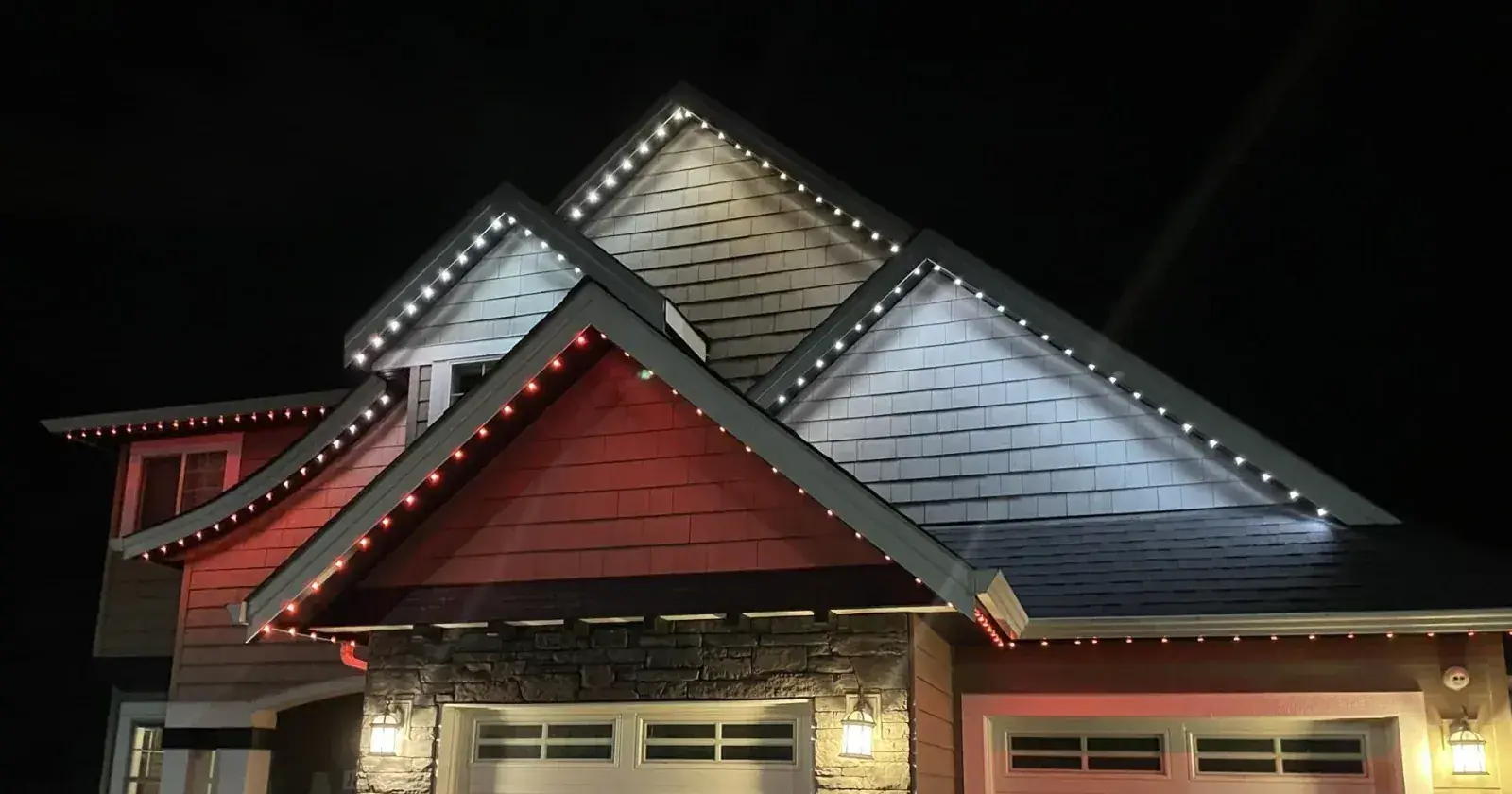
Permanent lights aren’t the right answer for every home. Here’s an honest side-by-side, including when traditional seasonal lights make more sense.
Permanent Christmas lights are installed once in a low-profile track and controlled from an app, so they work for every holiday and as everyday lighting. Traditional seasonal lights cost less upfront but have to be hung and taken down every year. Permanent lights suit homeowners who plan to stay put and want year-round use; seasonal lights can be the better choice if you’re moving soon, only want lights for a few weeks, or prefer a specific traditional look.
Permanent vs traditional Christmas lights at a glance
| Permanent lights | Traditional seasonal lights | |
|---|---|---|
| Installation | Installed once | Hung every year (by you or a hired installer) |
| Removal | Not needed | Taken down and stored every year |
| Year-round use | Holidays plus everyday warm-white accent lighting | Usually Christmas only |
| Customization | Millions of colours, effects and scenes from an app | Fixed by the strings you buy |
| Daytime appearance | Slim track along the soffit, colour-matched to trim | Strings and clips visible while up; nothing after removal |
| Maintenance | Occasional checks; app and controller updates | Checking strings each season; replacing failed strands |
| Upfront cost | Higher | Lower |
| Recurring cost | Running power; no yearly install | Yearly installation and removal if hired, or your own time; replacement strings |
| Convenience | Change colours from your phone | Ladder work every November and January |
| Professional installation | Recommended for track systems | Optional |
Annual installation and removal
This is the main reason people switch. Seasonal lights mean a ladder on a cold, often wet roofline every November, clips that loosen in the wind, and the same job in reverse in January. With permanent Christmas lights, that work happens once.
Year-round functionality
Seasonal lights are a Christmas decoration. Permanent lights are an exterior lighting system: warm white on everyday evenings, colours for Halloween, Canada Day, Diwali or a birthday, and full holiday scenes in December. If you’d use that year-round lighting, permanent makes more sense — see year-round accent lighting.
Customization
A traditional string gives you the colours you bought. A permanent system lets you change colour, brightness and effects from an app and set schedules, so the same lights can be classic warm white one week and red and green the next.
Daytime appearance
When seasonal lights come down, nothing is left on the house — a genuine advantage if you’d rather have nothing there for eleven months. Permanent lights stay up, but a track system is mounted along the soffit and colour-matched to the trim so it reads as part of the house in daylight. Exact colour matches can’t be guaranteed on every home, so it’s worth seeing the options against your trim.
Maintenance considerations
Seasonal strings get handled, stored and re-hung every year, which is when bulbs and connections tend to fail. A permanent system isn’t maintenance-free — controllers, apps and connections still need occasional attention — but it isn’t taken down and put back up every season.
Upfront and recurring costs
Permanent lights cost more upfront. Seasonal lights cost less to start, but if you hire someone to install and remove them, that cost repeats every year; if you do it yourself, it costs your time and replacement strings. How those compare over time depends entirely on your home and how many years you’ll be there, so we don’t publish payback claims. Our permanent lights cost guide explains what drives permanent pricing.
Convenience and professional installation
Once a permanent system is in, changing the display takes a few taps. Getting it in is the bigger job: track systems involve measuring, cutting, mounting and connecting runs along the roofline, which is why most homeowners have them professionally installed. Thinking about doing it yourself? See DIY vs professional permanent lights.
When traditional seasonal lights may be the better choice
- You’re renting or plan to move within a year or two.
- You only want lights for a few weeks in December and won’t use them the rest of the year.
- You love a specific traditional look — large C9 bulbs, greenery, wrapped trees — that a roofline track doesn’t replace.
- You’d rather have nothing on the house outside the holiday season.
- Your upfront budget is limited this year.
- Your strata or neighbourhood rules don’t allow permanent fixtures (check first — see strata permanent lighting).
Long-term value
Permanent lights tend to make the most sense when you’ll use them often, plan to stay in the home, and want to stop hanging lights for good. If that sounds like you, request a free estimate — every property is assessed individually.
FAQs
Are permanent Christmas lights worth it?
They’re worth it for homeowners who will use the lights year-round, plan to stay in the home, and want to stop hanging and removing lights every season. If you only want lights for a few weeks or are moving soon, seasonal lights may suit you better.
Do permanent lights look bad during the day?
Track systems are mounted along the soffit and colour-matched to the trim so they blend in. Matches get very close, though an exact match can’t be guaranteed on every home.
Can permanent lights do classic Christmas colours?
Yes — warm white, red and green, multicolour and effects are all set from the app.
Are traditional lights cheaper?
Upfront, usually yes. Over time it depends on whether you pay for yearly installation and removal and how long you stay in the home.